


 Muhammad Haqiqat —
In recent years, reference to “international law” has become one of the most common responses to global crises. But what is being observed in the behavior of the United States today no longer fits even into the framework of a violation or selective interpretation of the law; it is a sign of a conscious abandonment of the law as the rule of regulating global relations .
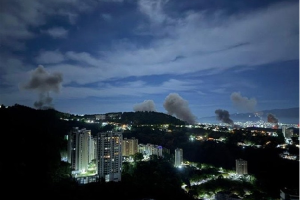
A nighttime raid on an independent United Nations member state, the kidnapping of its elected president and his wife, and then the explicit declaration that the invading power considers itself entitled to dictate the political structure, foreign relations, and economic policies of that country, requires neither legal interpretation nor can it be justified by concepts such as “humanitarian intervention” or “security.” This action is a direct negation of the principle of national sovereignty and a practical declaration of the invalidity of the international legal order.
The significance of this event is that even the pretense of law has been abandoned. There is no longer any question of resolutions, authorizations, or elaborate legal narratives; force is applied directly and then imposed as a “political reality.” This is the point at which international law is reduced from a tool for justifying power to something superfluous and subject to suspension.
This trend is not limited to Venezuela. The recent forcible seizure by the US Navy of a Russian tanker on the high seas—a vessel sailing under a legal flag and valid license—shows that even the most obvious principles of the law of the sea are not immune to the will of the dominant power. Here, we are no longer faced with the logic of “military conflict” or “exceptional circumstances of war,” but with the use of force in what should be the most neutral and law-abiding global arena.
This fact highlights an important distinction:
the issue today is not simply a matter of power competition or geopolitical conflicts; it is the place of law in the global order. If in some crises—such as the war in Ukraine—we can still speak of different interpretations, security considerations, and theoretical debates, what we are now witnessing is a stage beyond that: one in which law is not a point of contention but is deliberately set aside.
In such a situation, the main danger is not just the escalation of tensions but the normalization of the logic of force. When a dominant power can, without accountability, kidnap a country’s president, seize its resources, regulate its trade, and simultaneously carry out forced detentions on the high seas, the message is clear: the law is only for others.
This situation has consequences that go beyond one or more crises. The discrediting of international law means encouraging all actors to seek security through force. A world in which law is not a shield to restrain power is inevitably driven towards permanent instability.
It is necessary to criticize this process, not from the standpoint of favoring this or that power, but from the perspective of defending the principle of the sovereignty of nations and the minimal possibility of peace. Without a clear critique of imperialism—especially in the naked and undisguised form practiced today by the United States—any talk of order, law, and peace will sooner or later degenerate into unsupported moralism.
In the face of this dangerous trend, the role of progressive, leftist, and anti-imperialist forces cannot be limited to moral denunciation or verbal condemnation. What is needed is conscious, organized, and sustained action in defense of the principle of the sovereignty of nations and against the normalization of the logic of force. This action requires strengthening and expanding the peace movement, actively supporting legitimate forms of civil protest, and consciously building a network among anti-imperialist forces at the national and international levels; a network that can simultaneously resist psychological warfare and narratives of domination, alert public opinion to the danger of organized lawlessness, and create effective political pressure to curb aggression and restore law to the position of checking power. In a world where imperialism seeks to make bullying the norm, collective and responsible activism is not a tactical choice but a historical duty in defense of peace, human dignity, and the possibility of a more just future.