


 The rising tensions in the Caribbean and the Trump administration’s direct threats against Venezuela are not an isolated event or a bilateral conflict; they signal the return of a pattern that Latin America and the entire global South have repeatedly faced with devastating consequences—from Guatemala and Chile to Iraq, Libya, Afghanistan, and Panama in 1989. From the perspective of the anti-imperialist left, our task is not simply to describe these events; it is to analyze and expose the mechanisms that imperialist powers use to control nations, seize natural resources, and reshape the world order.
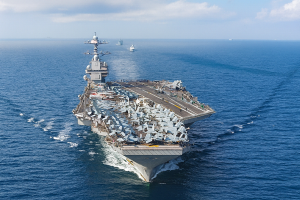
Today, what is being done against Venezuela is a continuation of the same familiar formula: security profiling, media narratives about the “war on drugs,” widespread economic pressure, covert operations for internal destabilization, and finally, the open threat of military action. The growing US military presence in the Caribbean—from the deployment of the Gerald Ford aircraft carrier and amphibious special forces to the terrorist designation of the “Cartel de los Soles” without providing credible evidence—can be understood within this framework. The historical experience of the region has also shown that whenever this path has been embarked upon, it has not led to security and development, but to economic chaos, political instability, and widespread displacement. This historical repetition doubles the need to carefully examine the current threats against Venezuela.
It is in this context that one of the most central means used in this cycle, namely building a scurity case should be considered. By claiming that Maduro leads an organized smuggling network, the US State Department seeks to create a legal and psychological basis for increased pressure or military action, while even independent experts—including researchers of organized crime—have questioned the existence of a unified “cartel” and acknowledge that the official narrative is more of a political label than a structural description. However, when the goal is not to truly combat transnational crime but to legitimize foreign pressure, narrative construction takes the place of truth; as we have seen in Iraq, Panama, Libya, and other well-known examples.
Alongside this narrative war, there are clear signs of ouvert and covert operations. The revelations about “Operation Phoenix”—a plan Venezuelan officials say was designed to infiltrate the country through some Caribbean islands—show that there are also subterranean operations underway. The pattern is consistent with the history of CIA covert operations in Central America: destroying critical infrastructure, attacking energy facilities, undermining defenses, and creating the conditions for internal destabilization. With the land borders on the Colombian side strengthened, the focus on the Caribbean route has only one message: Washington is opening up new avenues for pressure, influence, and disruption.
At the same time, it should be noted that such covert operations are usually preludes to larger scenarios; scenarios that have a clear precedent in Latin American history. This series of events is clearly reminiscent of the 1989 US invasion of Panama, the only case in recent decades when Washington launched a direct attack to change the regime in Latin America. This operation began with the claim of a “war on drugs” but ended with the complete destruction of the poor neighborhood of El Chorrillo, the deaths of hundreds to thousands of civilians, the widespread displacement of the working classes, and the continuation of the political and social crisis in Panama. Even today, the effects of that intervention remain on the lives of large groups of people. If such devastation occurred in a small country with a limited military structure, the imagining of its consequences in today’s Venezuela—a large, populous country with vast resources and under sanctions for years—is much more severe.
Panama’s experience shows that the humanitarian and social consequences of military intervention are immediate. Venezuela, which has been under severe economic pressure and sanctions in recent years, cannot afford another military shock. Attacks on energy infrastructure, refineries, the electricity grid, or command centers would quickly disrupt basic services and plunge the country into a cycle of humanitarian crisis: fuel shortages, reduced food production, hospital disruptions, and a collapse of the distribution system. Such a situation could trigger a wave of displacement of millions that neighboring governments—from Colombia to Brazil—would be unable to manage, plunging the region into a new phase of instability.
This social collapse will also have inevitable security consequences. The experience of Libya after 2011 showed how the destruction of central order leads to the flourishing of dozens of armed groups, smuggling routes, and illegal economies. Latin America, with its long history of cartels and paramilitary networks, is poised to face a new wave of armed actors if the Venezuelan government is weakened, a problem that would not only not end the crisis but also reproduce it indefinitely.
But one fundamental factor in imperialist calculations is often overlooked: the capacity of the Venezuelan people for organized resistance and long-term persistence. In the quarter century since the triumph of the Bolivarian Revolution, Venezuela has resisted all forms of aggression—from the 2002 coup and oil sabotage to economic blockades, financial warfare, and outright aggression scenarios—and has developed specific social structures that are today the main pillars of resistance. The vast network of communes, popular militias, local councils, participatory programs, and mass mobilization mechanisms have repeatedly demonstrated in moments of crisis that Venezuela is not a passive state, but a society with a hard core of resistance. In the event of any external attack, this popular capacity could lead to urban warfare, disruption of supply lines, expansion of resistance fronts, and erosion of enemy operations—a scenario whose political, economic, and human costs to Washington would be far greater than initially estimated. Historical experience across the global South has also proven that nations that fight for independence do not surrender.
Moreover, in recent years, Venezuela has become one of the most outspoken and consistent supporters of the Palestinian cause throughout the Americas, a support that plays a decisive role not only in its diplomatic aspect, but also in its symbolic and moral dimension in the global struggle against imperialism. For public opinion in the global South, the simultaneity of these two positions—Venezuela’s resistance to imperialism and its unconditional support for Palestine—provides a very clear picture of today’s global alignment: on the one hand, the front of popular resistance and independent states that stand against domination; and on the other, the bloc led by the United States and Israel that maintains the existing unequal order through sanctions, blockades, proxy wars, and support for counter-revolutionary forces.
These are not “separate issues,” but two different arenas of a single confrontation—a confrontation between the front of independence and justice, and the front of domination and intervention.
Internationally, this trend has implications beyond Latin America, and the reactions of governments show that concerns are not limited to the region. In recent weeks, both CELAC—particularly in a joint meeting with the European Union—and key regional governments such as Cuba, Nicaragua, Brazil, Colombia, and Mexico have taken clear positions in defense of Venezuelan sovereignty. Outside the region, China, Russia, and Iran have warned that attempting to legitimize aggression through “narcotics charges” is a direct violation of international law. Iran has rightly pointed out that even the 1988 Convention on Narcotics Control does not authorize such a move, and using this narrative to justify military action could become a dangerous model against any other sovereign state—from Nigeria to anywhere else in the global South.
In this regard, it is worth noting a simple but important fact: even UN reports and official documents from the US Drug Enforcement Administration (DEA) do not confirm the White House’s claims about the role of Maduro or the Bolivarian leadership in drug trafficking. This contradiction makes it clear that the “Cartel de los Sols” narrative is more a political tool for making a case and laying the groundwork for intervention than the result of a security assessment. When this model is combined with economic pressure, covert operations, and military threats, its regional and global consequences—for the international legal order and for the political balance of the South—go far beyond a bilateral conflict.
Behind this trend, the issue of the global political economy of drugs plays a decisive role. The fact is that most of the profits from this trade accumulate in American and European banks, while the violence, tension and human cost remain in the producing or transit countries. This structural gap – a direct result of the unequal global order – is part of the context that allows the US to use the narrative of the “war on drugs” not to solve the crisis, but to exert geopolitical pressure. Highlighting the role of Venezuela, when the main trafficking routes are elsewhere, is more a means of justifying political pressure than a security pursuit.
At the end of this analysis, what we are facing is not simply a crisis between Washington and Caracas; it is rather the clash of two opposing logics in the world order: on the one hand, the logic of hegemony, regime change, and the containment of sovereign states, and on the other, the logic of self-determination, social justice, and resistance to intervention. For the anti-imperialist left, defending Venezuela does not mean defending a specific state or leader; it is defending the principle of national sovereignty and resisting a model that has, for decades, plundered the resources of the nations of the South and plunged societies into poverty and instability. Wherever sanctions, blockades, and military aggression have been used—from Iraq to Libya, from Afghanistan to Panama—the result has been nothing but the collapse of social structures, increased poverty, and intensified violence. There is no sign that the Venezuelan scenario is an exception to this rule.
In the face of such a trend, neutrality and silence only pave the way for the repetition of past tragedies. If a world is to be built on independence, justice, and human dignity, the first step is to resist the recurring patterns of interventionism. We stand with the nations that are resisting the pressure of imperialism—not out of sentiment, but based on a historical experience that has repeatedly proven that no nation can develop or achieve social justice without preserving its sovereignty and right to self-determination. Today, Venezuela is the target; tomorrow it may be another country in Latin America, Africa, or Asia. Therefore, opposing US intervention in Venezuela is not a moral or regional duty; it is part of a global struggle for peace, equality, and the liberation of all nations that resist domination.
November 19, 22025 —