


 External Committee of the Supporters of Anti-Imperialist Left Alliance — Iran —
At this critical moment—when the United States and Israel are waging a devastating war against Iran—the responsibility of the anti-war movement, especially within the center of U.S. imperialism, is unequivocal: to oppose this war without ambiguity, and to reject the propaganda used to justify it.
The current assault on Iran is not an isolated event. It is the continuation of a decades-long campaign of aggression aimed at overthrowing a sovereign government. Central to this campaign has been a persistent effort to delegitimize the Islamic Republic of Iran through narratives centered on “human rights” and “democracy”—frameworks repeatedly weaponized to justify intervention, sanctions, and war.
Yet today, this very narrative is being echoed from within the antiwar movement itself.
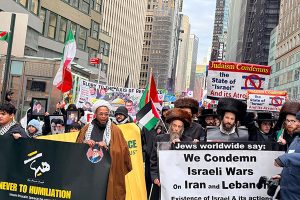
At the February 28 rally in Times Square, NYC, the day the U.S. launched the war, Jamal Abdi, president of the National Iranian American Council (NIAC), as the featured speaker and co-convenor, and partner of mass U.S. rallies, formally opposed U.S. bombing of Iran. But he simultaneously denounced the Iranian government as “repressive” “authoritarian” “elite who benefit from sanctions” and called for its replacement – regime change – under the banner of “democracy.” This contradiction is not incidental—it is politically consequential.
We must ask clearly: What does it mean to oppose war while endorsing the very ideological framework used to justify it?
Such a position does not challenge imperialism—it reinforces it. It aligns, whether intentionally or not, with a long-standing U.S. strategy of regime change pursued under the guise of “democratic reform”.
NIAC’s Political Role and Alignment
NIAC presents itself as a representative of Iranian Americans and engages in lobbying within U.S. political institutions. While such activity may appear legitimate, its political positions reveal a deeper alignment with U.S. strategic objectives.
As the largest, well funded, most often quoted Iranian American organization in U.S. media, NIAC has openly supported “targeted sanctions” against Iran, including its role in advancing the 2010 Stand with the Iranian People Act. These measures—while framed as selective—directly undermine the Iranian state’s capacity to provide essential services, impacting healthcare, education, infrastructure, and basic living conditions.
At the same time, NIAC has consistently failed to acknowledge the documented social and developmental achievements of Iran, including advances in public health, literacy, women’s participation in science and medicine, and technological self-reliance under extreme external pressure.
This selective narrative is not neutral. It reflects a political orientation that mirrors U.S. foreign policy discourse.
Moreover, NIAC’s funding connections to institutions such as the Ford Foundation and organizations linked to George Soros’ Open Society network further raise legitimate questions about its role within broader frameworks of U.S. “soft power”—efforts historically aimed at shaping political outcomes in targeted countries.
While NIAC claims that change in Iran must come from within, it simultaneously supports U.S.-backed initiatives to influence internal dynamics, including the promotion of external media penetration and digital infrastructure designed to disseminate U.S. narratives.
Introducing these narratives into the antiwar movement has serious consequences. It creates confusion among new activists, dilutes the clarity of anti-imperialist positions, and ultimately weakens the movement’s capacity to oppose war effectively. A movement that simultaneously opposes military aggression while legitimizing its ideological justification becomes internally contradictory—and politically ineffective.
No genuine antiwar movement can sustain itself while reproducing the narratives of the very forces it seeks to oppose.
Sign Petition in Support of Iran
Clear Position in Solidarity with Iran
At a time when Iran is under direct military attack, the task of anti-imperialist forces is clear:
- To defend Iran’s sovereignty and right to self-determination
- To oppose all forms of U.S. and Israeli aggression—military, economic, and ideological
- To reject propaganda that seeks to justify intervention under humanitarian pretexts
Solidarity does not require agreement with every aspect of a government. It requires a principled stance against imperialist domination and regime-change operations. This principle has guided solidarity movements with Cuba, Venezuela, Nicaragua, and other nations targeted by U.S. intervention. The same standard must apply to Iran.
The antiwar movement must remain grounded in clarity and principle. To oppose war is not enough. We must also oppose the narratives that sustain it. The injection of U.S. propaganda into spaces of resistance undermines solidarity, distorts political understanding, and ultimately serves the very system of domination we seek to challenge.
— Stand against war.
— Stand against imperialism.
— Stand in solidarity with Iran.
External Committee of the
Supporters of Anti-Imperialist Left Alliance — Iran
March 22, 2026
Sign Petition in Support of Iran